★★★★★
"AHHAC delivered our 22-zone underfloor system on time, on budget and to spec. The crew were tidy, the documentation was thorough, and the commissioning was textbook."
David Chen
Custom Builder · Mosman, NSW
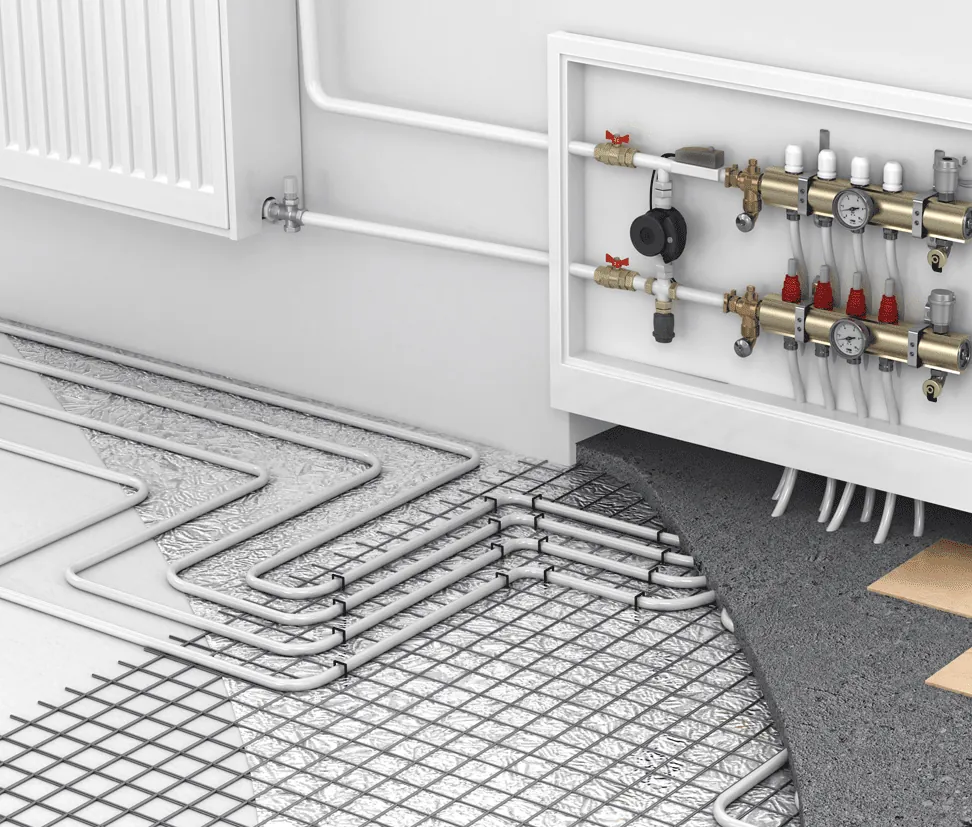
Both circulate warm water; both are quiet, even and healthy. But underfloor heating and hydronic radiators suit very different homes. Here's how they compare on warm-up speed, comfort, cost, retrofit and cooling — and how AHHAC chooses between them.

 ImmergasSimeThermaSkirt™
| Underfloor heating | Hydronic radiators | |
|---|---|---|
| Warm-up speed | Slow (2–8 hrs) — steady background | Fast (15–25 min) — heat on demand |
| Comfort | Most even; invisible; radiant floor | Even; radiant + convective panels |
| Running cost | Lowest — flow 35–45 °C | Low — flow 45–55 °C |
| Install cost (200 m²) | $22k–$55k | $12k–$30k |
| Retrofit | In-screed only; adds floor height | Easiest — no floor works |
| Aesthetics / space | Invisible — no wall units | Wall panels (can be features) |
| Zoning | Per-room thermostatic zones | TRV on every radiator |
| Cooling | Yes — reversible chilled water | No — heating only |
| Best for | New builds & new-floor renos | Retrofits, apartments, fast rooms |
Indicative figures; AHHAC sizes and quotes to your heat-loss calculation.
…you're building new or renovating with new floors, you want the most even and invisible warmth, you want the lowest running cost (its very low flow temperature keeps a heat pump at peak efficiency), or you want one system that also cools in summer. It's the premium, whole-home emitter.
→ Hydronic underfloor heating…you're retrofitting a finished home or apartment, you want fast warm-up and heat on demand, you want the lowest install cost, or you want a system in days rather than weeks. Modern low-temperature panels still pair efficiently with a heat pump.
→ Hydronic radiatorsBoth emitters do the same job — turn warm water from a heat pump or boiler into comfortable room heat — but they do it differently. Underfloor embeds PEX-A pipework in the floor (in the concrete slab for new builds, or in a thin screed over an existing subfloor) and turns the whole floor into a large, low-temperature radiator. Radiators are wall-mounted steel or aluminium panels that heat quickly and can be turned up or down room by room. Underfloor is a distributed, invisible, thermal-mass system; radiators are compact, responsive point sources. That single difference — mass vs responsiveness — drives almost every other trade-off below.
Radiators win decisively on speed: they warm a room from cold in 15–25 minutes, so they're perfect for spaces you use intermittently — bedrooms, studies, guest rooms — where you want heat now and off again when you leave. Underfloor is slow by design, taking 2–8 hours to bring a slab up to temperature; it's built to run as a steady, low-temperature background warmth rather than to blast on and off. On pure comfort, underfloor edges it: the warmth is perfectly even from floor to ceiling, there are no hot spots, and there's nothing on the wall. Radiators are also even and quiet, but they're a visible presence in the room (which some owners turn into a design feature with vertical or designer panels).
Underfloor is marginally cheaper to run because it operates at a very low flow temperature (35–45 °C), which is exactly the band where a heat pump is most efficient. Radiators run a little hotter (45–55 °C on modern oversized panels), so the heat pump works slightly harder — but the gap is small, and both are far cheaper to run than ducted electric or a resistive system. The heat source matters far more than the emitter here: a heat pump on either emitter will beat a gas or electric boiler on running cost. We cover the full picture in our hydronic heating cost guide.
This is where radiators pull ahead for existing homes. A full radiator system typically costs $12,000–$30,000 and installs in one to three days using a manifold-and-home-run pipe layout with no joins in walls and no floor works. Underfloor costs more — $22,000–$45,000 for an in-screed retrofit, $30,000–$55,000 for in-slab in a new build — and in a finished home the in-screed build-up raises the floor height. The rule of thumb: for a new build or a renovation with new floors, underfloor is a small incremental cost and the best result; for a retrofit into a finished home, radiators are usually the smarter, less disruptive spend.
Both give excellent room-by-room control — underfloor via per-room thermostatic zones at the manifold, radiators via a thermostatic valve (TRV) on every panel. On aesthetics and space, underfloor is invisible and frees every wall, which architects love; radiators occupy a section of wall but can be specified as slim panels, vertical design pieces, column radiators for heritage rooms, or dual-fuel towel rails in bathrooms. Neither compromises air quality — unlike ducted, there's no recirculated dust or dry air with either.
Only underfloor can. On a reversible heat pump, the same underfloor loops run chilled water in summer for silent, draught-free floor cooling — so one system covers both seasons. Radiators are heating-only. If year-round comfort from a single hydronic system matters to you, that tips the scales toward underfloor (or toward adding fan coils). See our guide to radiant floor cooling for how it works.
Because we install both, the recommendation follows your home, not our stock. We start with a heat-loss calculation, then weigh the build (new vs retrofit), how you use each room (constant vs intermittent), budget, and whether you want summer cooling. Very often the best answer is a blend: in-slab underfloor through the open-plan living areas for even, invisible, coolable comfort, and fast-response radiators in bedrooms, bathrooms and additions. Both run from the same heat source, so a hybrid system is straightforward. For the wider technology choice, see our guide to ducted vs hydronic heating, and avoid the classic sizing pitfalls with our guide to mistakes to avoid.
"AHHAC delivered our 22-zone underfloor system on time, on budget and to spec. The crew were tidy, the documentation was thorough, and the commissioning was textbook."
"We've worked with AHHAC for 17 years. They've installed and serviced our hot water plant across three commercial buildings — and they pick up the phone on weekends."
"Three mobs quoted us; AHHAC's design was the only one based on a proper heat-loss calculation. The system runs beautifully — the others would've been oversized and expensive."