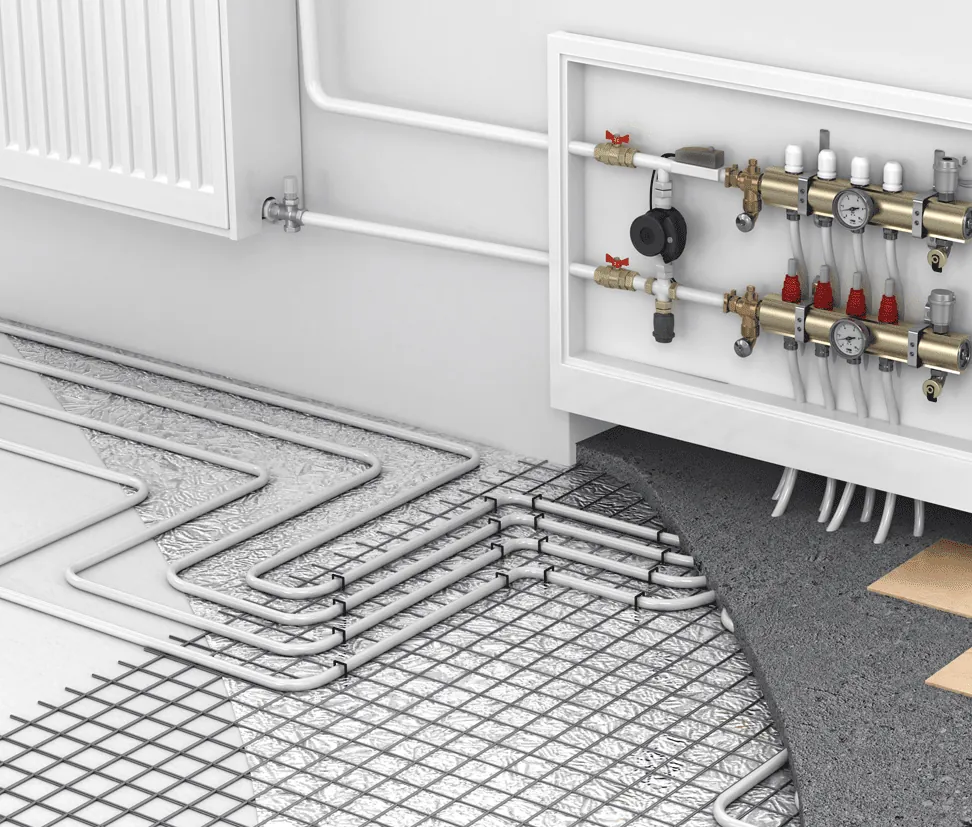
- A whole-home hydronic system typically costs $20,000–$60,000+ installed, depending on size, emitter and heat source.
- Underfloor is the premium option; radiators are cheaper and easier to retrofit.
- A heat pump costs more up front than a gas or electric boiler but far less to run — usually the lowest lifetime cost.
- The single biggest cost mistake is quoting without a heat-loss calculation. Insist on one.
The short answer
For a typical Australian home, a complete hydronic heating system generally costs somewhere between $20,000 and $60,000+ installed. That's a wide band because "hydronic heating" covers everything from a handful of radiators in a two-bedroom apartment to a fully zoned in-slab underfloor system with a heat pump in a 400 m² architectural build. As a rough guide: radiators in a small home start around $12,000–$20,000; a mid-size home with underfloor and a heat pump lands around $30,000–$55,000; and large or commercial systems run higher. The rest of this guide breaks down what moves the number, because the honest answer to "how much does hydronic heating cost" is always "it depends on your home" — and any installer who quotes a firm price without seeing your plans is guessing.
What actually drives the cost
Five things move a hydronic quote more than anything else. Home size and heat loss — bigger, leakier homes need more output and more pipework. Emitter type — underfloor costs more to install than radiators, but disappears into the build. Heat source — a heat pump, gas boiler or electric boiler each have very different up-front and running costs. Number of zones — more thermostatic zones mean more manifolds, valves and controls. And new build vs retrofit — laying pipe into an open slab is far cheaper than retrofitting into a finished home. Get these five right in the design and the price is predictable; get them wrong and you either overpay or end up with a system that can't hold temperature.
Cost by emitter: underfloor vs radiators
Hydronic underfloor heating is the premium emitter — silent, invisible, and beautifully even. For a 200 m² home, in-slab underfloor typically runs $30,000–$55,000 with a heat pump; in-screed retrofits are usually $22,000–$45,000. Radiators are the value option: a full-home radiator system usually falls in the $12,000–$30,000 range and installs in days, not weeks, because there's no slab work. Radiators also warm up far faster and are the easiest system to retrofit. Neither is "better" in the abstract — they suit different homes, which is why we wrote a full comparison of underfloor heating vs radiators. For a deeper underfloor-specific breakdown, see our underfloor heating cost guide for Sydney and Melbourne.
Cost by heat source: heat pump vs gas vs electric
The heat source is where up-front cost and running cost pull in opposite directions. An electric boiler is the cheapest to install (a compact wall unit, no flue) but the most expensive to run. A condensing gas boiler sits in the middle on both — modest install cost, running cost tied to the gas price. A hydronic heat pump costs the most up front (typically $8,000–$18,000 for the unit and install) but runs at a COP of 3.5–4.5, so it's three-to-four times cheaper to run than the boilers — and it can cool in summer too. For most homes the heat pump wins on lifetime cost, especially with rooftop solar. Our guide to electric boiler vs heat pump hydronic heating works through exactly when each option makes sense. AHHAC sizes and quotes all three so you can compare.
Running costs — the number that matters more
Install cost is a one-off; running cost is forever, and over a 20–30 year system life it dwarfs the up-front difference. This is where the heat source dominates. A resistive electric system runs at a COP of 1.0 — one unit of electricity, one unit of heat. A heat pump runs at 3.5–4.5, turning each unit of electricity into three-and-a-half to four-and-a-half units of heat. On a cold-climate home that difference is hundreds of dollars every winter. Pair a heat pump with rooftop solar and daytime running cost falls close to zero. The Australian Government's energy.gov.au guidance and the Your Home design guide both make the same point: how efficiently you generate and move heat matters far more to your bill than the appliance's sticker price.
New build vs renovation
Timing changes the maths dramatically. In a new build, in-slab underfloor pipe is laid into the open slab before the pour — the marginal cost is low because the trades and access are already there. Adding cooling later is cheap too, because the network is shared. In a renovation, you're working around finished floors, walls and joinery: in-screed underfloor or radiators become the practical choice, and labour is a bigger share of the bill. The rule of thumb: if you're building or doing a major renovation with the slab open, underfloor is a small incremental cost and the best long-term result; if you're retrofitting a finished home, radiators usually give the best value and the least disruption.
Rebates and incentives
Be careful with rebate claims here, because most incentives target hot water, not hydronic space heating. Small-scale Technology Certificates (STCs) under the federal Small-scale Renewable Energy Scheme apply to registered heat pump and solar water heaters — not to air-to-water heat pumps used for hydronic space heating — and their value shrinks each year as the scheme winds down towards 2030. State programs such as Victoria's Solar Victoria hot water rebate, Victorian Energy Upgrades and the NSW hot water upgrade incentive likewise focus on hot water (and, for heating, mostly on reverse-cycle air conditioners). The ACT's Sustainable Household Scheme offers low-interest loans for electrification. So budget for a hydronic heat pump without assuming a rebate, and treat any hot-water incentive as a bonus. Our heat pump rebates guide sets out what each state currently covers, and we confirm eligibility for your exact products at quote stage.
Is it worth it — and how to get an accurate quote
Hydronic heating costs more up front than a ducted air conditioner, and for the homes it suits it's worth it: quieter, healthier, more even comfort, lower running cost, and a 30-year design life that adds resale value. But the figure only becomes real once someone has calculated your home's heat loss. The most expensive mistake in this industry is a system sized on a rule of thumb — undersize it and it can't keep up; oversize it and it short-cycles and wastes money. Our guide to mistakes to avoid explains why we refuse to quote without a heat-loss calculation. If you'd like an accurate, itemised, fixed-fee quote, send us your plans — see our Sydney, Melbourne or Canberra pages for local detail, or explore the systems on our hydronic heating and cooling hub.