The short answer
UpdatedHydronic heating's biggest pros are comfort and longevity: silent, even, radiant warmth with no blown air, room-by-room zoning, and pipework with a 30+ year design life. Its main cons are a higher upfront cost (roughly $20,000–$60,000+ for a whole home), slow response from in-slab underfloor, limited cooling unless you add fan coils, and real disruption in a finished home. Driven by a heat pump it is cheap to run. It is worth it in cold climates and new builds; in mild, cooling-led homes, often not.
Reviewed by the AHHAC Technical Team — licensed plumbers & hydronic engineers, NSW Lic 262528C.How we write & review
- Biggest pros: silent, even radiant warmth, no forced air or blown dust, per-room zoning and a 30+ year design life on the pipework.
- Biggest cons: upfront cost ($20k–$60k+ for a whole home), slow in-slab response (2–8 hours from cold) and no cooling from radiators.
- Running cost is decided by the heat source: a heat pump (COP 3.5–5.5) is far cheaper to run than a gas or electric boiler.
- Clear winners: Canberra, Melbourne and cold NSW, new builds and long-term owners. Weak case: small, cooling-led Brisbane homes.
- Most hydronic regrets trace back to poor design, not the technology — insist on a room-by-room heat-loss calculation.
How hydronic heating works (and why it feels different)
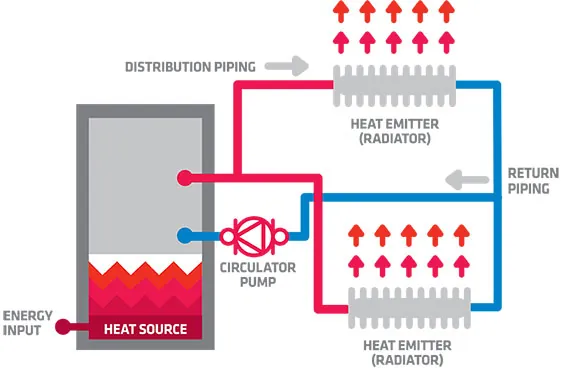
Hydronic heating heats water, not air. A heat source — a hydronic heat pump, a condensing gas boiler or an electric boiler — warms water that a small circulating pump sends through sealed PEX pipework to emitters in each room: hydronic underfloor heating loops, panel radiators, skirting or fan coils. The water gives up its heat, returns to the heat source and goes round again.
The emitters warm you mainly by radiation — the way a sunny brick wall warms you on a winter morning — rather than by blowing hot air around. Underfloor systems run at low flow temperatures of around 35–45 °C, radiators at roughly 45–55 °C. That low, steady temperature is the source of most of the pros below, and its slow response is the source of a few of the cons.
Hydronic heating pros and cons at a glance
This is the honest summary we give clients before any design work starts.
| Pros | Cons |
|---|---|
| Even, radiant warmth — no draughts, no warm-face, cold-feet effect | Higher upfront cost than split or ducted reverse-cycle systems |
| Silent in the room — no indoor fans on underfloor or radiators | In-slab underfloor is slow to respond (2–8 hours from cold) |
| No forced air, so far less dust and allergen movement | Radiators can't cool; cooling needs fan coils or careful underfloor design |
| Per-room zoning with thermostats or radiator valves | Retrofits can be disruptive (floor height, wall space, pipe routes) |
| Cheap to run on a heat pump, especially with rooftop solar | Expensive to run on an electric boiler in a large home |
| 30+ year design life on the pipework; heat source can be swapped later | Needs annual servicing and correct water treatment |
| Underfloor is invisible and frees up wall and ceiling space | Design-sensitive — a poor install is costly to fix |
The rest of this guide unpacks each line, because the weighting is different for every home.
What are the advantages of hydronic heating?
Comfort you notice on the first cold morning
Radiant heat warms the people, floor and furniture in a room rather than the air up near the ceiling. Temperatures stay even from floor to head height, and there are no blasts of warm air cycling on and off. Many owners find they're comfortable at a slightly lower thermostat setting than with forced-air heating — which, as the running-cost section below shows, has a real effect on the bill.
Better for allergy and asthma households
Underfloor and radiator systems don't blow air, so they don't stir up dust, pet hair and pollen or push it through ducts. We're careful not to oversell this — hydronic heating doesn't filter your air, and good ventilation still matters — but for many allergy-prone households the absence of forced air is the single reason they choose it.
Silence
There are no indoor fans on underfloor, radiators or skirting. The only moving parts are a circulating pump in the plant area and, with a heat pump, an outdoor unit. Bedrooms, studies and nurseries stay genuinely quiet.
Room-by-room control
Every zone gets its own thermostat, or each radiator its own thermostatic valve, so you heat the living areas in the evening and the bedrooms overnight — not the whole house all day.
Longevity and flexibility
The pipework network has a 30+ year design life. The heat source can be changed later — a gas boiler today, a heat pump when you electrify — without touching floors or walls. The same system can run heated towel rails, and a reversible heat pump can add summer cooling through the same network.
What are the disadvantages of hydronic heating?
Upfront cost
Hydronic is a premium system. A whole-home install typically runs $20,000–$60,000+, which is more than ducted reverse-cycle costs in most homes and many times the price of a couple of split systems. Radiators sit at the lower end of that range; in-slab underfloor with a heat pump at the upper end. The cost section below breaks it down.
Slow response from underfloor
An in-slab system takes roughly 2–8 hours to bring a cold slab up to temperature. It's designed to run as steady background warmth on a schedule, not to be switched on when you walk in the door. If your household is out all day and wants heat the moment you're home, hydronic radiators (15–25 minutes from cold) are the better match.
Cooling is limited
This is the con people most often discover too late. Radiators and skirting can't cool. Underfloor can deliver gentle cooling with chilled water, but it needs dew-point control and won't pull down a 38 °C afternoon on its own. For real summer cooling you add fan coils off a reversible heat pump — see hydronic cooling systems — or keep a reverse-cycle air conditioner for the hottest rooms.
Retrofit disruption
In-slab underfloor is a new-build option. In an existing home, in-screed underfloor raises floor height and only suits rooms where floors are being replaced, while radiators need wall space and pipe routes through the subfloor, roof space or cupboards. It's very achievable — our guide to retrofitting hydronic heating walks through it step by step — but it's more involved than mounting a split system.
Maintenance and design sensitivity
Hydronic systems want an annual service, correct inhibitor levels and, in older systems, a power flush every 5–7 years. More importantly, they're unforgiving of bad design: undersized emitters or a guessed heat source can leave rooms cold for decades. That's why we never quote without a room-by-room heat-loss calculation.
Is hydronic heating expensive to run?
It depends almost entirely on what heats the water. The emitters and pipework barely move the bill; the heat source does.
| Heat source | Efficiency | Upfront cost | Running cost | Best for |
|---|---|---|---|---|
| Air-source heat pump | COP 3.5–5.5 (3.5–5.5 kW of heat per kW of electricity) | Highest — typically $8k–$18k for the unit and install | Lowest; near zero on daytime solar | Most homes, especially long heating seasons |
| Condensing gas boiler | About 90% (COP ≈ 0.9) | Moderate | Medium; tied to gas prices and supply charges | Homes keeping gas, high-temperature radiators |
| Electric boiler | About 100% (COP 1) | Lowest | Highest | Small apartments, light or occasional use |
A heat pump typically runs at 65–75% lower cost than the same system on gas, because it moves heat from the outside air rather than making it. Pair it with rooftop solar and schedule more of the heating through the day and the marginal cost drops further — in-slab underfloor in particular stores daytime warmth in the slab for the evening. On an electric boiler, hydronic is genuinely expensive to run in a large home; on a heat pump, it's one of the cheapest ways to heat a whole house.
Habits matter as much as hardware. The Australian Government's energy.gov.au winter guidance recommends heating to 18–20 °C and notes that every extra degree adds roughly 5–10% to heating energy use — so radiant comfort at a lower setting, and heating only the zones you're using, both show up on the bill.
How much does hydronic heating cost to install?
As a guide from our own installs: a radiator system for a full home usually falls around $12,000–$30,000; a 200 m² Sydney home with in-slab underfloor and a heat pump typically lands around $30,000–$55,000; in-screed underfloor retrofits are usually $22,000–$45,000. Rebates mostly target the hot-water side: federal STCs apply to registered heat pump and solar water heaters rather than hydronic space-heating heat pumps, so budget for the heating system without assuming a rebate.
What moves the number most is home size and heat loss, emitter type, heat source, number of zones and whether the slab is open. A firm price given without a heat-loss calculation is a guess. Our hydronic heating cost guide goes deeper on each factor.
How long does hydronic heating last?
Longer than any air-based system. The PEX pipework and manifolds carry a 30+ year design life, and quality panel radiators are similarly long-lived. The part that eventually wears out is the heat source: a quality hydronic heat pump has a 15–20 year design life, and when it's due you replace the outdoor unit while the rest of the system keeps running. Compare that with ducted reverse-cycle, where the whole installation is typically a 12–18 year proposition — our ducted vs hydronic heating comparison sets out the full trade-off.
That longevity is also the resale argument. In cold-climate markets such as Canberra and Melbourne, buyers recognise hydronic heating as a premium feature, and an invisible underfloor system doesn't date a home the way wall units and ceiling vents can. We won't put a dollar figure on it, but it's rarely a feature buyers want taken out.
Hydronic heating pros and cons by climate
The same system can be an obvious win in one city and a hard sell in another. Heating-degree-days (HDD) measure how cold and how long a heating season is — and they change the weighting of every pro and con above.
| City | Heating demand | Verdict | What we'd typically specify |
|---|---|---|---|
| Canberra | Very high — 2,000+ HDD, −5 °C design temperature | Strongest case in Australia; running cost dominates | Cold-climate heat pump; underfloor in new builds, radiators in retrofits |
| Melbourne | High — about 1,500 HDD, −1 °C design temperature | Strong case for long-term owners | Heat-pump underfloor for new builds; radiators for period homes |
| Sydney | Moderate — about 700–900 HDD | Good for comfort-led buyers, new builds, the upper North Shore and inland suburbs | Radiators or underfloor on a heat pump with solar; plan cooling separately |
| Brisbane | Low — a fraction of Melbourne's | Weak for heating alone; works as a reversible heat-and-cool system | Reversible heat pump with fan coils and dew-point control |
For local design detail, see hydronic heating in Canberra, hydronic heating in Melbourne and hydronic heating in Sydney. In Brisbane, the honest question isn't whether you want a heater — it's whether you want one system that heats and cools.
Who hydronic heating suits — and who should choose something else
It's a strong choice if you…
- are building new or renovating with floors up — the incremental cost of underfloor is lowest now;
- live with a long, cold heating season;
- have allergy or asthma concerns, or simply dislike the noise and draught of forced air;
- plan to stay ten years or more and value a 30+ year system;
- want to go all-electric with rooftop solar and a heat pump.
Choose something else if you…
- mainly need cooling — a reverse-cycle air conditioner will do that better and for less;
- only want heat in one or two rooms for a few weeks a year — a split system is far cheaper;
- are renting, or selling within a couple of years;
- have a tight budget in a finished home with no floor works planned;
- could only run it on an electric boiler in a large home.
Plenty of our clients land in between: hydronic heating for the living areas and bedrooms, plus a reverse-cycle unit for the hottest room in summer.
Is hydronic heating worth it? Our verdict
For the right home, yes — by a wide margin. In a cold climate, in a new build or major renovation, driven by a correctly sized heat pump, hydronic heating gives you the most comfortable winter you can buy, low running costs and a distribution system that outlasts two generations of air conditioners. For a mild-climate home that needs cooling more than heating, or a short-term owner on a tight budget, it usually isn't — and we'd rather tell you that at the quote than after the install.
The pattern behind almost every disappointed hydronic owner we meet is the same: a system that was never properly designed. Sized to a rule of thumb, the wrong emitter for the household's routine, the wrong heat source for the tariff. If you're weighing it up, start with a heat-loss calculation and a straight conversation about how you actually live in the house.
Sources & how this guide was written
- Manufacturer datasheets for the heat pumps, boilers and emitters we install (COP, flow temperatures, design life).
- AS/NZS 3500 (plumbing and drainage) and AS/NZS 5601 (gas installations), the standards we install to.
- The Australian Government's energy.gov.au winter heating guidance on thermostat settings, cited above.
- Bureau of Meteorology climate data and the design temperatures we use in heat-loss calculations for each city.
- AHHAC design, install and service experience across 2,400+ hydronic systems in NSW, the ACT, Victoria and Queensland since 1998.
This guide was written and reviewed by the AHHAC Technical Team — licensed plumbers and hydronic engineers (NSW Lic 262528C). Prices reflect our 2026 installs, and we'll next review it before winter 2027.