★★★★★
"AHHAC delivered our 22-zone underfloor system on time, on budget and to spec. The crew were tidy, the documentation was thorough, and the commissioning was textbook."
David Chen
Custom Builder · Mosman, NSW
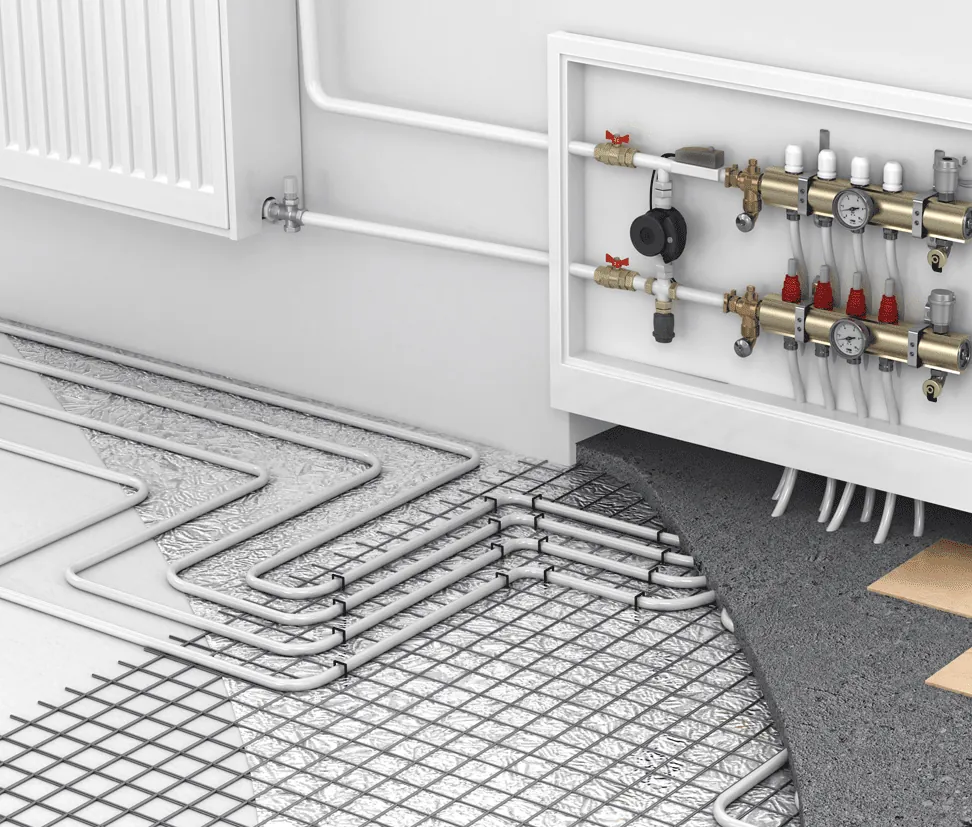
In-slab and in-screed hydronic underfloor heating for Canberra new builds and renovations, driven by a cold-rated heat pump. The slab's thermal mass rides through the ACT's freezing nights, delivering silent, even, whole-home warmth. Designed and installed from our Fyshwick showroom.

 ImmergasSimeThermaSkirt™
In Canberra's climate, hydronic underfloor heating isn't a luxury — it's the emitter the conditions were made for. With well over 2,000 heating-degree-days a year, sub-zero mornings and heavy frosts, the ACT has a long, genuine winter, and in-slab underfloor answers it perfectly: warm water circulates through PEX-A pipework cast in the concrete slab, turning the whole floor into a silent, invisible radiator that holds its warmth through the coldest Canberra night. Heat rises evenly from the ground up — no draughts, no fan noise, no dust — for comfort a ducted system simply can't match over a cold season. This page is part of our wider hydronic heating Canberra service, run from our Fyshwick showroom.
The efficiency case is just as strong. Underfloor runs at a very low 35–45 °C flow temperature, which is exactly the band where a hydronic heat pump is most efficient — so pairing Canberra underfloor with a cold-rated Maxa i-290 (rated to −25 °C) delivers a seasonal COP of 4-plus even through ACT frosts. Every kilowatt of electricity becomes four-plus kilowatts of heat, at a fraction of the running cost of gas or resistive electric, and it pairs perfectly with rooftop solar. For the emitter detail see our hydronic underfloor heating page.
Whether you're building new, doing a knock-down rebuild or renovating a Canberra home, underfloor delivers the most even, lowest-running-cost warmth available — and it can cool in summer too. It all starts with a heat-loss calculation done to Canberra's real design temperature.
For new builds and rebuilds, in-slab is the default: pipework is cast within the concrete slab before the pour, giving a large thermal mass that stores heat and rides through Canberra's freezing overnight lows — ideal for the ACT's cold, still winter nights. For renovations and second storeys, in-screed is the answer: a low-profile 12 mm pipe in a 30–35 mm self-levelling screed over the existing subfloor, faster to respond and compatible with engineered timber, tile, stone and most carpets. In a cold climate, correct insulation under and around the slab edge is critical — it's the difference between heating the home and heating the ground — and it's a detail cheaper installs routinely skimp on.
Across 2,000-plus heating-degree-days, the heat source's efficiency compounds into serious money. We build Canberra underfloor systems around the cold-rated Maxa i-290 heat pump, which holds full output to −25 °C so it doesn't fade or lean on expensive backup elements on frosty mornings. Underfloor's low flow temperature keeps it in its most efficient band all winter. Gas boilers are a valid alternative where gas is connected, but with the ACT phasing out new gas connections, an all-electric heat-pump underfloor system is the future-proof choice. Our comparison of electric boiler vs heat pump and our Canberra running-costs guide work through the numbers.
This is the step that separates a Canberra system that works from one that struggles. A heat-loss calculation must use Canberra's design temperature — far colder than Sydney's — or the system will fall short on the coldest mornings. AHHAC models every ACT job room by room, sizes the heat pump and pipe layout to the real load, and commissions the system so it's balanced and quiet. Skipping the calculation is the classic, expensive installer error; see our guide to mistakes to avoid.
Underfloor gives the most even, invisible warmth and is ideal for new builds; for renovations and rooms you want to warm quickly, European panel radiators in Canberra respond faster. Many ACT homes blend the two — underfloor through the living areas, radiators in bedrooms and additions — all run from one heat pump. Our comparison of underfloor heating vs radiators lays out the trade-offs, and our guide to ducted vs hydronic heating explains why hydronic outperforms blown air in the cold.
On a reversible heat pump, the same underfloor loops run chilled water in summer for silent floor cooling through Canberra's hot, dry summer days — one all-electric system, both seasons; the physics is in our guide to radiant floor cooling. From our Fyshwick showroom we cover Canberra, Queanbeyan, Bungendore and Yass, and every job runs the same way: consult and site visit; heat-loss calculation, design and fixed-fee quote back within 24 hours; in-house install to AS/NZS standards; and full commissioning with a documented handover. For the wider service area see our hydronic heating Canberra page.
Last updated 30 September 2026 · AHHAC
"AHHAC delivered our 22-zone underfloor system on time, on budget and to spec. The crew were tidy, the documentation was thorough, and the commissioning was textbook."
"We've worked with AHHAC for 17 years. They've installed and serviced our hot water plant across three commercial buildings — and they pick up the phone on weekends."
"Three mobs quoted us; AHHAC's design was the only one based on a proper heat-loss calculation. The system runs beautifully — the others would've been oversized and expensive."