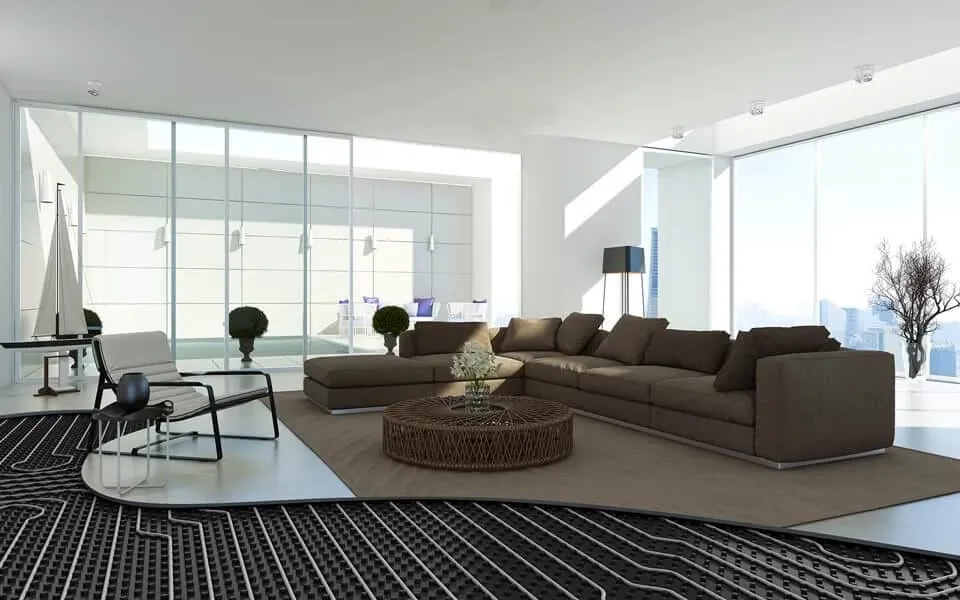
- Hydronic cooling circulates chilled water through underfloor loops or fan coils to absorb heat from each room.
- It's near-silent, draught-free and runs roughly 25–40% cheaper than ducted air-conditioning.
- Humidity is managed with dew-point control so floors never sweat — this is the make-or-break design detail.
- If you already have hydronic heating, adding cooling is often just a reversible heat pump on the same pipework.
What hydronic cooling actually is
Hydronic heating moves warmth around your home in water. Hydronic cooling does the exact opposite: it circulates chilled water — typically around 14–18 °C — through the same kind of pipework, quietly absorbing heat from each room and carrying it back to a heat pump to be rejected outside. There's no blown air, no ducting roaring in the roof, and no fan noise in the room. The building itself becomes the radiator, in reverse.
Because it runs on the same network as your heating, one system can do both seasons. That's the elegance of it — and the reason we design so many Australian systems as heat-and-cool from day one. The category overview lives on our hydronic cooling systems page.
How chilled water cools a room
There are two main delivery methods, and most homes use a blend of the two.
Underfloor cooling. The in-slab or in-screed loops that warm your floor in winter run chilled water in summer. The floor surface drops to around 19–21 °C and gently draws radiant heat out of the room and everything in it — including you. It's completely silent and invisible, and it feels like a cool, calm room rather than a breezy one. We explain the physics in our guide to the cooling potential of radiant floor systems, and the comfort case in benefits of hydronic underfloor cooling.
Fan coils. For faster, deeper cooling — hot days, west-facing glazing, higher loads — discreet hydronic fan coils blow room air gently across a chilled-water coil. They respond quickly and add dehumidification. Think of underfloor as the quiet baseline and fan coils as the on-demand boost.
The humidity question — and why it's not a problem when done right
The first thing people ask is: won't chilling the floor make it sweat? It's a fair question, and the answer is engineering. We fit dew-point sensors that continuously watch room humidity and automatically raise the chilled-water temperature if the air gets close to its condensation point. The floor is never allowed to drop below the dew point, so it never sweats. In humid coastal climates we also size a small fan-coil dehumidification stage to pull moisture out of the air directly.
Done properly, decades of European installations and our own work across Sydney, Melbourne and Queensland show zero condensation issues. Done cheaply — without dew-point control — is exactly how you get a wet floor. It's the single most important detail, and it's covered in our guide to mistakes to avoid.
Hydronic cooling vs ducted air-conditioning
On comfort, hydronic wins clearly: no draughts, no dust or allergens recirculated through the house, and near silence. On running cost, it wins too — water transports heat far more efficiently than air and there are no large fan motors to power, so hydronic cooling typically runs 25–40% cheaper than an equivalent ducted air-conditioner. The Australian Government's Your Home guide and energy.gov.au both underline how much efficiency and comfort depend on how you move heat around the home, not just the appliance you buy.
Where ducted still competes is upfront cost in an existing home with no hydronic network — see our full ducted vs hydronic heating comparison for the honest trade-offs.
What it costs, and when it makes sense
The economics are strongest when cooling shares the heating network. If you're already installing hydronic heating — or building/renovating with the slab open — adding cooling is a modest incremental cost, because the expensive part (the pipework and the heat pump) is already there. A single reversible heat pump such as the Maxa i-290 supplies both winter heating and summer chilled water, keeping the whole system all-electric and solar-ready.
Retrofitting cooling as a standalone into a home with no hydronic network is possible but rarely the cheapest path — a good split or ducted system may make more sense there. We'll tell you honestly which way the numbers fall for your home.
Adding cooling to an existing hydronic system
Good news for existing hydronic owners: if your system is heat-pump-ready, adding reversible cooling can be as simple as switching to (or adding) a reversible heat pump and fitting cooling controls and dew-point sensors to the existing loops. Underfloor loops designed for heating can usually carry chilled water; some homes add one or two fan coils for peak-day capacity.
The best first step is an assessment of your current plant and pipework. If you're in New South Wales, start with our hydronic cooling Sydney page; anywhere in Australia, ask us for a cooling retrofit review and we'll come back within 24 hours.