★★★★★
"AHHAC delivered our 22-zone underfloor system on time, on budget and to spec. The crew were tidy, the documentation was thorough, and the commissioning was textbook."
David Chen
Custom Builder · Mosman, NSW
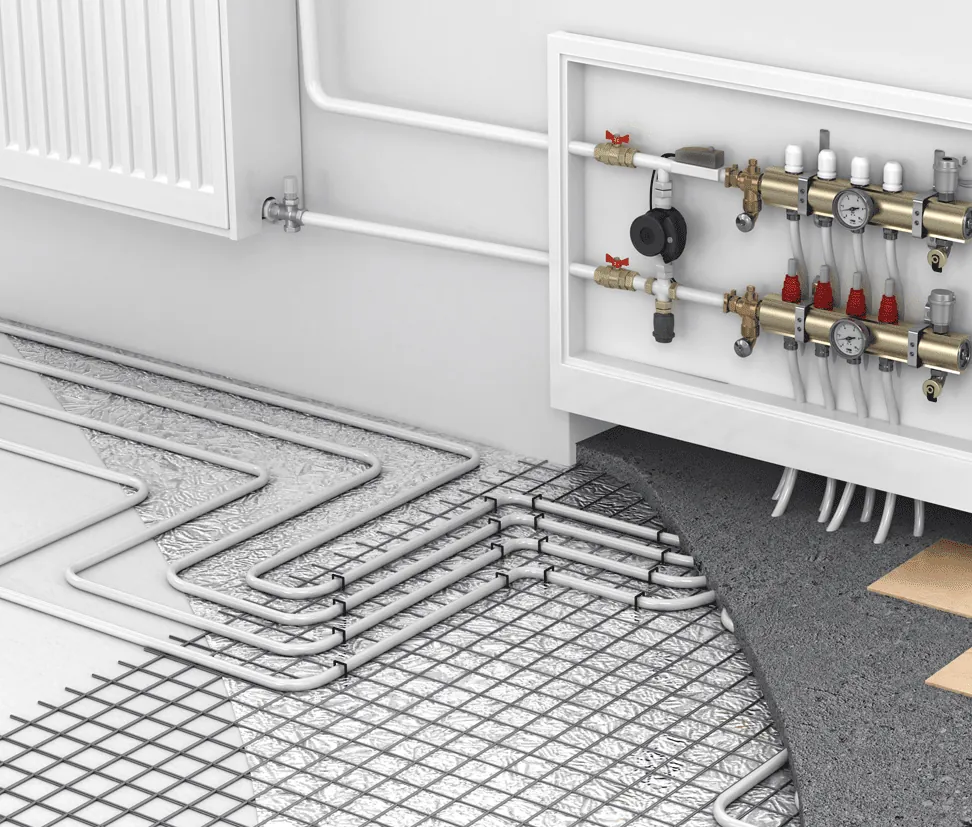
In-slab and in-screed hydronic underfloor heating (hydronic slab heating) for Sydney new builds and renovations, driven by a heat pump or gas boiler. Warm floors from Mosman to the Sutherland Shire, designed and installed from our Punchbowl showroom and quoted within 24 hours.
Hydronic underfloor heating in Sydney typically costs $30,000–$55,000 installed for a 200 m² home with in-slab pipework and a heat pump, while in-screed retrofits for existing homes usually fall between $22,000 and $45,000. Warm water at just 35–45 °C circulates through PEX-A pipe beneath tile, stone, timber or carpet for silent, even warmth. AHHAC designs every Sydney system from a room-by-room heat-loss calculation and installs from our Punchbowl showroom.
Reviewed by the AHHAC Technical Team — licensed plumbers & hydronic engineers, NSW Lic 262528C.How we write & review

 ImmergasSimeThermaSkirt™
Hydronic underfloor heating is the quiet luxury of a well-built Sydney home. Instead of blowing warm air around a room, warm water circulates through PEX-A pipework beneath your floor, turning the entire slab into a gentle, invisible radiator. Heat rises evenly from the ground up — no draughts, no fan noise, no wall units and no dust blown through the house. For new builds and major renovations across Greater Sydney it is the gold-standard emitter, and AHHAC designs and installs it end-to-end from our Punchbowl showroom.
Sydney's temperate climate (roughly 700–900 heating-degree-days, milder than Melbourne but with genuinely cold winter mornings inland and on the upper North Shore) is well suited to hydronic underfloor heating. Because the whole floor radiates at a low surface temperature, the room feels warm at a lower air temperature than a ducted system needs — which is where the efficiency comes from. Underfloor runs at just 35–45 °C flow temperature, and that low flow temperature is exactly where a hydronic heat pump is at its most efficient, so pairing Sydney underfloor with a Maxa or Immergas heat pump gives the lowest running cost of any heating system for a well-insulated home.
Whether you are searching for hydronic slab heating for a knock-down rebuild, hydronic floor heating for a Federation renovation, or underfloor for a new architectural build, the same principles apply — and they all start with a proper heat-loss calculation, never a rule of thumb. AHHAC serves all of Sydney, and this page is part of our wider Sydney hydronic heating service.
There are two ways to put hydronic underfloor into a Sydney home, and the right one depends on whether you are building or renovating. In-slab is the default for new builds and knock-down rebuilds: PEX-A pipework is clipped to the reinforcement and cast within the concrete slab before the pour. The slab becomes a large thermal battery that holds warmth through Sydney's cool mornings and evens out temperature swings — ideal for open-plan living areas and homes with a lot of glazing. In-screed is the renovation answer: a low-profile 12 mm pipe laid in a 30–35 mm self-levelling screed over your existing subfloor, adding only a small build-up to the floor height. In-screed responds faster than in-slab and is compatible with engineered timber, tile, stone, vinyl and most carpets, which makes it the practical choice for second storeys and heritage renovations where you cannot lift the whole floor.
For a typical 200 m² Sydney home, in-slab underfloor paired with a heat pump generally runs $30,000–$55,000 installed, depending on the number of zones, the heat source and the complexity of the build. In-screed retrofits usually fall in the $22,000–$45,000 range. The biggest cost drivers are the heat source (a heat pump costs more up front than an electric boiler but far less to run), the number of thermostatic zones, and the floor area. Because underfloor is a 30+ year system, it is best judged on lifetime cost rather than sticker price — and it adds genuine resale value to a Sydney property. For the full breakdown, read our underfloor heating cost guide and our new hydronic heating cost guide for Australia.
For Sydney's mild-to-moderate climate, a hydronic heat pump is almost always the smart choice. Underfloor's low 35–45 °C flow temperature keeps a Maxa i-290 or i-32V5 in its most efficient band, delivering a seasonal COP of 4 or more — every kilowatt of electricity becomes four-plus kilowatts of heat. Pair it with rooftop solar, which Sydney has in abundance, and daytime running cost falls close to zero. Where mains gas is already connected and the client prefers it, a condensing gas hydronic boiler is a valid alternative, and for tight apartments with no room for a heat pump an electric boiler can make sense. We size and compare all three at design stage. To understand the trade-offs, our guide to ducted vs hydronic heating explains why hydronic wins on comfort and running cost for the homes that suit it.
Underfloor works under almost any finish — stone, marble, tile, engineered timber, vinyl and most carpets — provided the design accounts for the finish's thermal resistance and maximum surface temperature. Solid hardwood needs species and humidity consideration. Every room is put on its own thermostatic zone via MAXA controls, so bedrooms, living areas and bathrooms each hold their own set point and schedule. The single most common failure we are called in to fix is an underfloor system installed without a heat-loss calculation — the pipe spacing is guessed, the system can't be balanced, and rooms run cold. Our guide to mistakes to avoid when installing underfloor heating walks through exactly what to check before you sign with any installer.
The same underfloor loops that heat your Sydney home in winter can run chilled water in summer, gently lifting heat out of each room through the floor. It is silent, invisible and draught-free, and on a reversible heat pump it costs little more to add. For higher cooling loads or west-facing glazing we add a fan coil or two for peak-day boost. The physics is covered in our guide to radiant floor cooling, and you can read the whole picture on our hydronic cooling Sydney page.
Every AHHAC Sydney job follows the same four stages: a consult and site visit; a heat-loss calculation, zone plan and fixed-fee design back within 24 hours; an in-house install to AS/NZS standards with neat, photographed pipework; and commissioning with a documented handover. We cover the Eastern Suburbs, Inner West, Lower and Upper North Shore, Northern Beaches, the Hills, Sutherland Shire and out to the Blue Mountains from our Punchbowl base.
Plenty of owners assume hydronic underfloor heating in Sydney is only for new builds. The in-screed method brings it within reach of many existing homes, from Federation cottages in the Inner West to 1970s brick houses on the North Shore and apartments undergoing a full renovation. It suits some projects far better than others, though, so it pays to know what you are signing up for before the floors come up.
On site the sequence is predictable. Rooms are cleared and existing finishes removed, pipework is laid and pressure-tested, the screed is poured, and then it must dry before tiles or timber go down. Flooring trades need a moisture reading before they start, so we build that drying time into the renovation programme with your builder rather than letting it surprise anyone. The heat source is installed in parallel, so the system can be commissioned as soon as the floors are finished.
Our step-by-step guide to retrofitting hydronic heating covers the wider process, and pairing the new floor with a reversible heat pump hydronic heating system in Sydney means it can cool in summer as well as heat in winter.
Written from on-site experience by the AHHAC Technical Team.
AHHAC's in-house design and service team — licensed plumbers and hydronic engineers (Lic 262528C) who have designed and installed 2,400+ hydronic heating, cooling and hot water systems across Australia since 1998.
We design hydronic underfloor heating from a room-by-room heat-loss calculation, install it with our own licensed plumbers to AS/NZS 3500 (plumbing) and AS/NZS 5601 (gas), commission and document it, and service it for the life of the system. Nothing is subcontracted out.
Last updated · AHHAC
"AHHAC delivered our 22-zone underfloor system on time, on budget and to spec. The crew were tidy, the documentation was thorough, and the commissioning was textbook."
"We've worked with AHHAC for 17 years. They've installed and serviced our hot water plant across three commercial buildings — and they pick up the phone on weekends."
"Three mobs quoted us; AHHAC's design was the only one based on a proper heat-loss calculation. The system runs beautifully — the others would've been oversized and expensive."