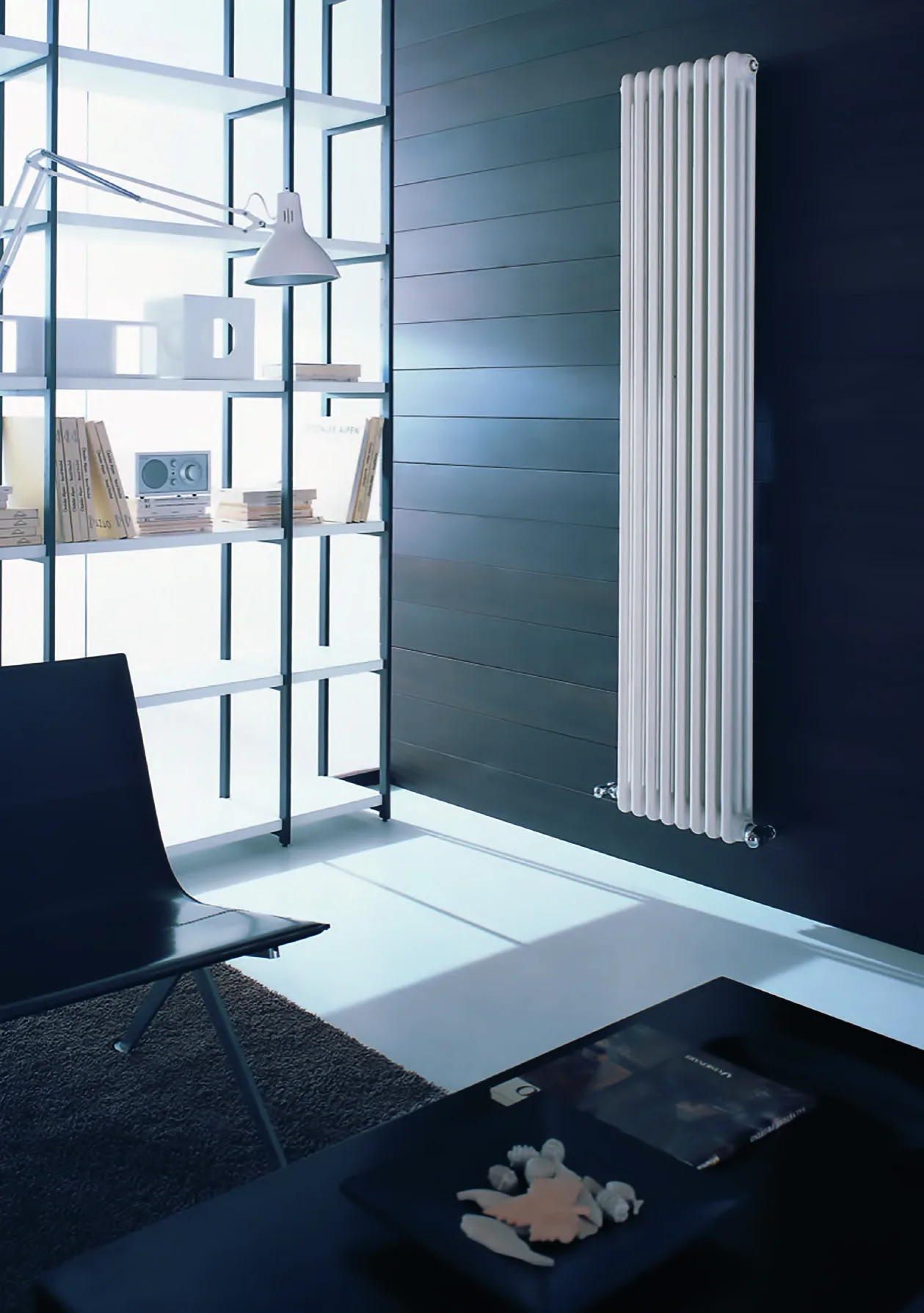
Melbourne has Australia's largest stock of older gas-boiler radiator systems. Decades of long, cold winters, around 1,500 heating degree-days a year with a −1 °C design temperature, left homes across the eastern suburbs, the inner north and bayside with a boiler in the laundry or roof space and a steel panel under almost every window. Many of those boilers are now near the end of their life, and a large share of our hydronic radiators Melbourne work starts with the same question: can the radiators stay when the gas boiler goes? Usually most of them can. The skill is in knowing which ones cannot.
A radiator is a simple thing, a steel panel with water flowing through it, but its output depends heavily on how hot that water is. Most older Melbourne systems were sized around a gas boiler running very hot water. A heat pump is at its most efficient with much cooler water, and at those temperatures an existing panel gives out noticeably less heat than the figure on its label. In a well-insulated bedroom that rarely matters. In a big living room with a wall of glass it can mean a room that never quite gets warm in July. So before we quote any conversion, we re-run a room-by-room heat-loss calculation and check every panel's output at the new flow temperature, then upsize, add or replace only where the numbers say so.
AHHAC supplies and installs hydronic heating radiators for Melbourne homes, from IMAS and De'Longhi panels to column radiators and heated towel rails, for new systems, radiator replacement and conversions across Greater Melbourne from our showroom at 43B Patch Circuit, Laverton North. Our in-house licensed plumbers and hydronic engineers handle the design, installation and commissioning, and the fixed-fee design and quote come back within 24 hours of the site visit. This page is part of our wider hydronic heating Melbourne service; for how radiators work in any home, see hydronic radiator heating.
ΔT: why heat pumps change the radiator maths
Radiator outputs in a catalogue are quoted at ΔT50, the EN 442 test condition: water averaging 70 °C in a 20 °C room, a 50-degree difference. That is close to how a traditional gas boiler ran. A heat pump works best at much lower water temperatures, and output does not fall in a straight line as the temperature drops; it falls faster. As our hydronic radiator sizing guide shows, a panel rated at ΔT50 and run on a heat pump typically delivers roughly a third to a half of its catalogue figure.
That is not a reason to avoid radiators with a heat pump; it is a reason to size them for it. In practice the fix for an under-performing room is one of four things: a deeper panel in the same position (a K22 replaced with a K33), a longer or taller panel, a second radiator on another external wall, or reducing the heat loss first with ceiling insulation, draught-sealing or better glazing. A fifth option, running the whole system hotter to suit the weakest room, works but costs efficiency in every hour of every winter, so we use it sparingly. Heat pumps also prefer a higher flow rate and a smaller temperature drop across the system than boilers did, so we check pipe sizes and the circulating pump as well as the panels.
Radiator replacement in Melbourne: replace, upsize or keep?
A sound steel panel can last for decades, and we do not replace radiators for the sake of it. Our assessment of an existing Melbourne system looks at each panel in turn:
- Output at the new flow temperature. Compared room by room with the calculated heat loss. Usually only a handful of rooms need a bigger or additional panel.
- Condition. Pinhole leaks, rust along the bottom seam or weeping around the valves mean replacement, not repair.
- Cold spots. Cold at the top usually means trapped air; cold along the bottom usually means sludge. Sludge and magnetite will clog a new heat exchanger, so we test the water and carry out a central hydronic heating flush and re-dose with inhibitor before any new heat source is connected.
- Valves. Seized or missing thermostatic radiator valves are replaced so each room can settle at its own temperature, which also helps protect a heat pump from short-cycling.
The full conversion process, from buffer tank to switchboard capacity, is set out in our guide to how to replace a gas hydronic boiler with a heat pump.
Panel types: K11, K21, K22 and K33
Steel panel radiators are named by their construction. The first digit is the number of water panels and the second the number of convector fin layers behind them, so a K11 is a single panel with one set of fins, a K22 two panels with two sets, and a K33 three of each. The deeper the radiator, the more heat it delivers from the same wall footprint, which is why a K22 or K33 is often the answer under a window where a longer panel will not fit. We install the IMAS steel panel range across all four types, plus flat-fronted panels for a cleaner, modern face, so panel radiators in Melbourne homes can be matched to both the heat loss and the interior.
Victorian and Edwardian homes
Melbourne's period homes are among the best candidates for radiators. Most Victorian and Edwardian houses sit on suspended timber floors over a ventilated subfloor, so we can run insulated pipework underneath and bring it up to each radiator through the floor, with no chasing of ornate plaster and no ducting bulkheads. High ceilings, single-glazed sash windows and draughty fireplaces all add heat loss, so these rooms are exactly where correct sizing matters most. Many owners choose IMAS Klassic column radiators, which sit naturally in period interiors, and for the most discreet option ThermaSkirt skirting-board heating replaces the skirting and disappears entirely. You will find suburb-specific advice on our hydronic heating Kew, hydronic heating Hawthorn and hydronic heating Camberwell pages.
Heated towel rails
A heated towel rail is the most-used radiator in most Melbourne homes. The IMAS Alubain aluminium towel warmers come in curved or flat ladder profiles, in heights from 745 to 1,735 mm, warm quickly, and offer the option of an electric element so towels still dry in summer when the heating is off. Bathrooms are usually set warmer than the rest of the house, which reduces a towel rail's output at low flow temperatures further, so we size them with extra margin rather than treating them as decoration.
IMAS radiators, ex-stock in Australia
IMAS radiators are Italian-made and distributed in Australia by Next Cycle. Because popular steel panels, flat panels, Klassic columns and Alubain towel rails are held in local stock, a Melbourne replacement does not have to wait the 8–12 weeks a European import can take, which matters most mid-winter, when a leaking panel or an undersized lounge radiator needs dealing with now. The IMAS flat panel range is tested to EN 442 and carries a 10-year guarantee. See the full range on our IMAS radiators page, or compare IMAS with De'Longhi and other options on our main hydronic radiators page.
Choosing the heat source
For most Melbourne radiator systems the heat source we now recommend is an all-electric heat pump hydronic system, such as the R290 Maxa i-290, with a heating COP of 4.94 on the 16 kW model and sizes from 6 to 27 kW. With radiators correctly sized for it, a heat pump typically costs 60–75% less to run than gas. If you would rather stay on gas for now, a condensing boiler such as the Viessmann Vitodens 100-W, up to 98% efficient, is a sound replacement, and it also benefits from larger radiators, because a condensing boiler only reaches its best efficiency when the water returning to it is cool. Either way, note that Victorian Energy Upgrades heating incentives cover air-to-air reverse-cycle units, not hydronic heat pumps; our heat pump rebates guide explains the current position.
Radiators, underfloor or both?
Radiators warm a room from cold in 15–25 minutes and retrofit into an existing home without lifting floors. In-slab underfloor responds over hours but gives the most even, invisible warmth, and suits new builds and extensions; see hydronic underfloor heating Melbourne. Many Melbourne homes use both, with underfloor in a new rear extension and radiators in the original rooms, all on one heat source. One limit to know: radiators heat only. If you want cooling from the same system, a reversible heat pump can feed hydronic fan coils on their own circuit. For a three-way comparison, read ThermaSkirt vs radiators vs underfloor heating.
Cost, service area and who radiators do not suit
A complete hydronic radiator system typically costs $12,000–$30,000 installed, depending on the number of rooms, the panels chosen and the heat source. Upgrading or replacing panels on an existing system is quoted panel by panel after the heat-loss check. From Laverton North we cover Greater Melbourne, the Mornington Peninsula, the Yarra Valley and hydronic heating Geelong and the Bellarine. Radiators are not the right answer for everyone: if the house is being gutted and re-floored anyway, underfloor may serve you better, and if insulation is very poor, fixing that first is often cheaper than buying bigger panels.